![map[email:you@example.com name:Alex Mihnev]](/images/avatar.png)
HE-2: Socratic dialogue with my brain, over text messaging
Introduction
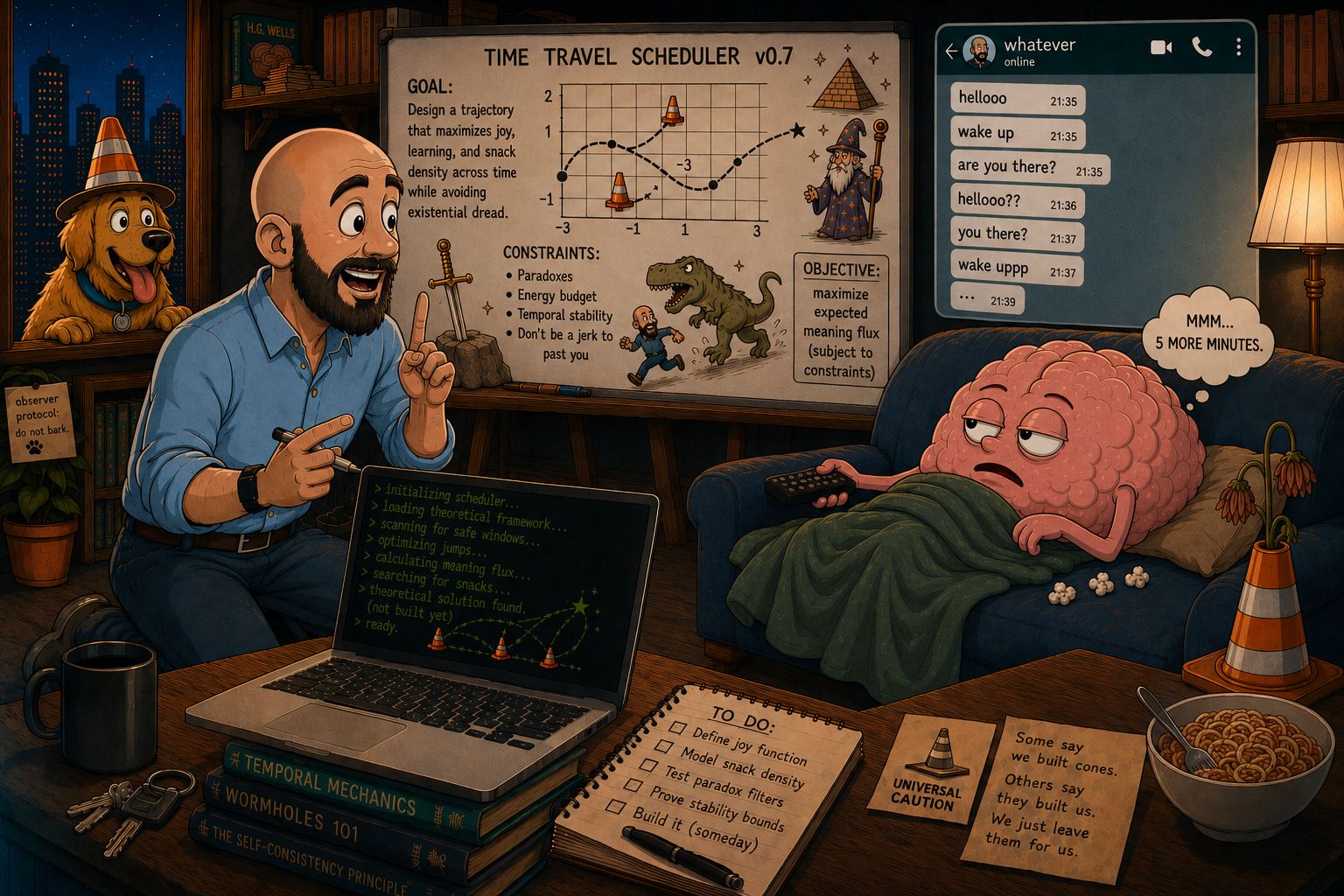
Our story begins with a random dude when the shadow of an idea started knocking on his mind's door. Before you start with the jokes -- the knocking wasn't due to a lose screw! Not before too long our guy realized that, to understand what the idea wants from him, it may be necessary to employ his brain -- surprising, I know. Naturally, just like others from his generation and extroverts in general, he had outsourced most of his critical reasoning skills to stuff he saw on the internet and his social network in general. Luckily, our hero lived in a timeline where his own brain was part of his social network.
Just go with it, ok?

He was asleep in front of the TV
He covered his face with a pillow, as if to become invisible.
He sat up, annoyed.
The resistance
As you can probably tell the brain wasn't too happy about having to work on his free time which was understandable. He had entertained some other rather questionable hobby projects and was justifiably uninterested.
who told you you needed a scheduler for your portfolio? Haven't you been optimizing for a living for like 4 years now?
...Google.
✓✓He was glancing at the TV. Clearly, he had better things to do.
Shockingly, these two were kind of similar. The bald dude was also jumping through hoops not to write the damn thing but was incapable of accepting defeat. The painful paradox was resolved by remembering a crucial fact.
Creative license
If the internet said a scheduler was needed then it's the internet's fault for not being more explicit with the constraints. This meant that the job did come with a license for creative freedom... How much of human innovation was due to finding loopholes -- be they in law or physics?
The problem with creative freedom is always the unbounded solution space. Ideas are both there and they aren't. One has to pick the first nonsense that springs to mind and go from there. Like shooting in the dark. Have you ever wondered whether the shit that sticks to the wall is actually random?
This is where stuff was being thrown at the wall.
The brain turned the TV up.
It was worth a try but it's clear the brain needed something more specific. Down to one last Hail-Mary it is.
Loops
The guy must've been experiencing a bad writer's block because he was going for the meta -- writing about his writer's block (basically, not being specific). It's a lot like that influencer economy online which makes content about being an influencer.
Damn loops everywhere.
They both realized they have the ability to think to themselves and not just answer each other.
Wait a second. If the dude didn't know his brain any better, he could've concluded that it was somehow helping him with these tidbits. Was he interested but also saving face?
Getting time travel involved
Going for loops was dangerous but not out of character. Why was he trying to lean on the one thing he was told to avoid in modeling from day 1? Maybe this was the only time he could play around with the forbidden fruit -- muses love this stuff, it's like a dark arts cheat code for creativity.
Many have travelled back to this moment in time to witness the event. Rumor says you could literally hear the penny drop and there was a reward for capturing it on audio.
And so the idea finally revealed itself.
Conclusion
Sometimes I wonder whether we're living in the world of ideas instead of ideas living in our world.
Could we be the reproductive system of ideas? Or is it that we're just conduits for them to enter our world from some sort of infinite information space?
Someone once told me that an idea was worthless without execution. Although I profoundly disagree that ideas are worthless, I do agree that their value (and plagiarism) increases once you prove they can work.
How can you make a scheduler for time travelers if you don't know how time travel works? Hell, how does time even work? I'm sure some claim to know. Although, can anyone truly know without being able to mess with it, disassemble and then reassemble it without leftover screws?
I call that screwptimization.
As far as I'm concerned, time is a subject ripe for the taking and as such -- an excellent breeding ground for ideas and fiction, which will be exactly what this chapter is about.
We have to start with a mental model of time.
Regardless of whether it's fiction or truth, a good mental model must:
- rely on the least amount of exceptions, and
- have the highest possible level of internal consistency, and ideally
- glide smoothly along Occam's razor.
So let's get to it.