Series
This article is part of the series The history of history engineering (HE-X)
HE-7: The topology of possibility

If the pasta model is correct, then the only way for time travel to be possible is for the multiverse to not be deterministic. The only (believable) way for the multiverse to be probabilistic under the same constraints is if it's a simulation. And it seems to behave like an optimization simulation in general, where the alternative timelines are independent optimizations -- like stochastic sampling.

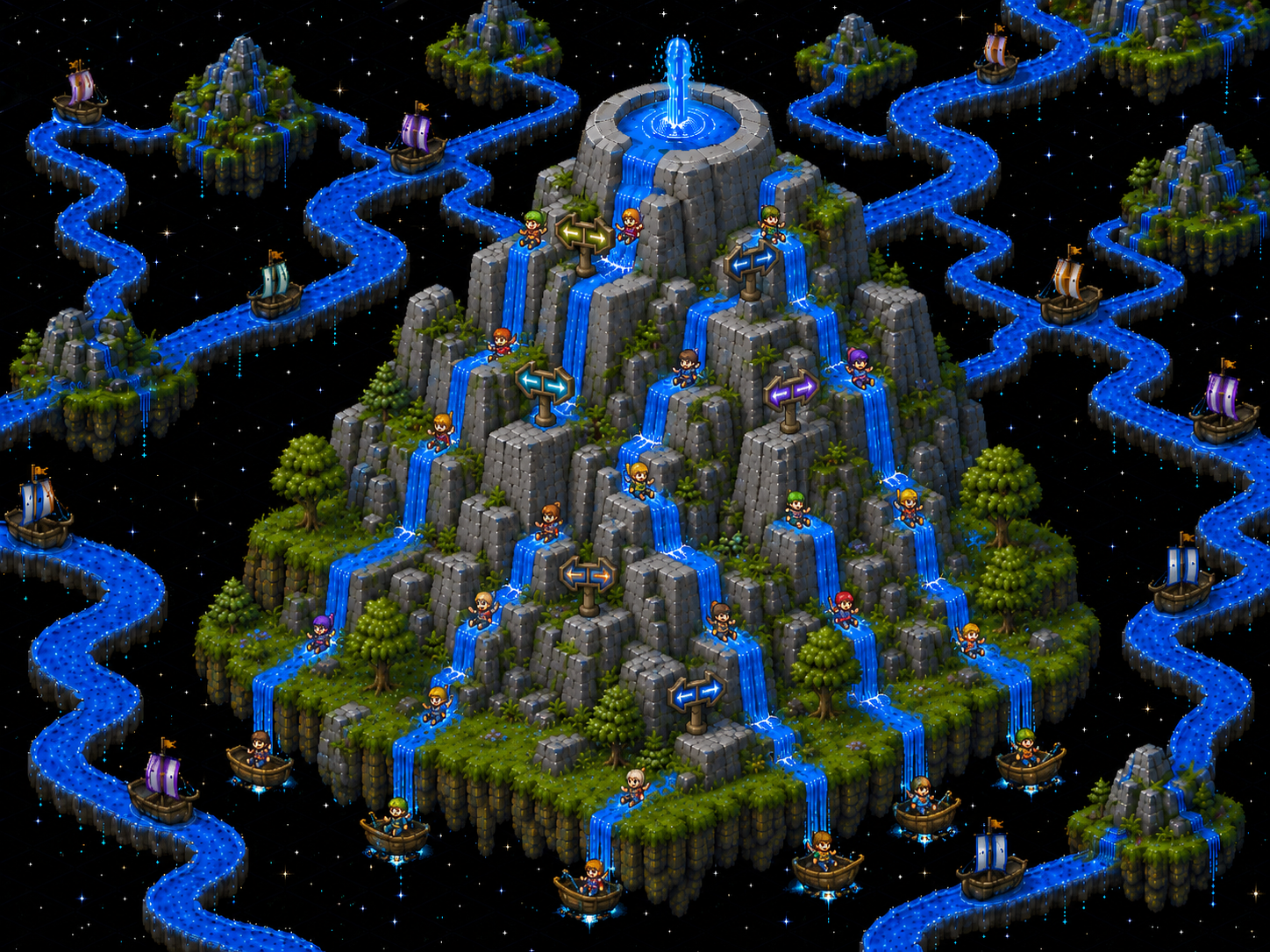
A multiverse of forks in the road

The logical conclusion is that all choices are thus possible in this multiverse, so there is an infinite amount of alternative timelines. A reason to run the optimization experiment is to see which choices in this network are more popular than others. At the same time we have to be careful not to lean to an extreme of probabilism because that could also remove the need for free will -- if everything is entirely stochastic.

Which brings us to the next question -- could the multiverse be entirely probabilistic?
Message
Brain
Brain
What if it's not a simulation? Computing efficiency wouldn't matter then. Not everything needs to be recomputed so you could freely jump around.
You desperately want alternative timelines but you don't want the idea of a simulation, which easily permits them? Interesting choice.✓✓
Hey, you like your free will. I need to not be some eldritch creature's lab experiment.
Ok but we talked about this. Time travel doesn't work if it's not a simulation. The whole Big Bang/white hole problem.✓✓
I disagree. Perhaps you were right about the white holes and creating new instances. But there could already be plenty of developed timelines to choose from.
You said it yourself, if the universe is an optimization algorithm then the alternative timelines are alternative samples. The only plausible explanation we could find was that it's trying to see how choices look like statistically. This implies a very heavily probabilistic multiverse with every single choice being present as an alternative sample. This means that an alternative timeline would exist for everything!
Jumping around would then be safe(ish) without being deterministic.
This isn't refuting the idea for a simulation. It's supporting it even.✓✓
Not necessarily. This infinite interconnectedness could be a natural structure in the computing substrate. No need for a simulation specifically (is a simulation the less likely explanation according to Occam's razor?). I just figured out how the sampling space to make an optimization would look like and realized such a structure doesn't need to be simulated. Think an underground cave system and water (causality) flows through it.
I must admit tho that if you were to model the multiverse, an optimization may be your best bet.
It's a cool explanation. I don't see why is it so important for you that it's not a simulation even if it does everything a simulation does and allows you to make your own choices.✓✓
You're basically saying there's a map of all that's possible as a combination of choices so whatever I do must therefore fall somewhere within that map. No paradoxes. No need to create anything from nothing.✓✓
Exactly.
It feels elegant as a solution but almost implies that there are no alternative timelines per se. At least not discretely, as everything is continuous then. For example, I'm walking down a path, encounter a fork in the road. At the very instance I make a choice about which path to take an alternative version of me is spawned and takes the opposite path. It's a little confusing.
I like your approach and see why you're being confused. There's a simple rescue. It's important to make a distinction between the network topology (i.e. everything that's possible) and an individual solution (a specific path being taken through the network topology). The cave system in the analogy above is the blueprint of the object, and the individual flow of water through it is the instance. Of course, if you summarize all the paths across all timelines it would look like you just split into multiple people at each choice but in reality each of the combinations of sequential choices would've been a separate timeline.✓✓
Think less about things being next to each other and more about things being on top of each other. Like a sandwich.✓✓
You sure know snacks is how to get me on your intellectual side.
How does that fit with the pasta model tho?

Simulation or not, the multiverse could be an infinite network of decisions. Which means that each timeline is an independent path through this network.

What happens when you change a decision?

The pasta can be a little confusing because the spaghetti look linear but that doesn't imply the topology is linear. The spaghetto is just a vector which is a list of choices made.✓✓
Then what about the whole thing about intersecting spaghetti? They intersect at choices?
They do, yes. The idea is that different timelines could've differently arrived at the same choice. In mathematical (or spaghetti) space this would look like intersections of the otherwise straight vectors.✓✓
So what about jumping between them? Suppose I'm from the future and go back in past somewhere along the length of the spaghettus.
Isn't it called a spaghetto?
Not when it comes to time travel so holster that smartarse, boy.
I make you take a different path. What happens then? Does the pasta model still hold?
Yes it must hold but the caveat is that in doing so you would transport yourself to a different timeline, one where I made the other choice. This must change the future AND the past like we talked about it before.✓✓
Yes, we did but why should it change both?
Because this new choice may lead me to other future choices which are incompatible with the past as the one you are aware of. Suppose you make me study arts instead of STEM. This may take me to a future choice about what famous sculpture to build, or movie to film. What if I needed to have a specific piece of inspiration from the past which I wouldn't have otherwise but that would've pushed me to study arts?✓✓
Is it really so extreme?
Of course not. There would be plenty of overlap in a multiverse of infinite possibilities. Some timelines could be nearly identical, so mostly compattible, and only diverge at one choice. We're just talking extremes as they stress-test our model best.✓✓
Ok so that means I wouldn't necessarily change the past and could do this to change the future?
It's a little complicated because the only change will be for you. To your timeline it would appear that you've disappeared at some point. Then you appeared into a different timeline (which was specific to allowing you to jump there). At this point you making me change my choice may have been factored in so the other choice never truly existed for me to begin with. However, in the spirit of free will let's suppose you could've made me make any choice. This would just result in you shifting to the respective timeline.✓✓
But we're back at the start again. You're once again talking about a deterministic multiverse. The timeline events are fixed, the difference is which ones are spun up for me. We just found an excuse for alternative timelines to exist and for me to jump between them at my choice.
I must admit, it does sound a bit depressing. Perhaps even lonely. You are powerless to change anything, only escape from it.✓✓
...Although. Did we just solve for me finally winning the lottery??
You should be glad. It looks like it's possible.✓✓

The pasta model makes a little bit more sense now. The multiverse is like a bowl of pasta. Each spaghettus is a separate timeline which is nothing more than a ledger of what decisions were taken and in what order. If you're more visually-minded then you could think as the universe as a pie lattice and the timeline is a unique path through this lattice.

It's all about the carbs, obviously.

Speaking of changing decisions and how you don't really change a decision in this model... what's the role of time travel in all of this? A cool perk?

[ < Prev ] [ Next > ]